
Improve the Economics of Growth.
Growth becomes more valuable when the business can deliver it efficiently. GOP helps identify operating priorities that can strengthen productivity, margins, execution and management discipline.
How do manufacturers improve margins and capacity without new capital? GOP works on the shop floor and in the supply chain to raise output, cut waste and lower cost per unit, often within existing space and assets. The work covers flow, changeover, layout, procurement, working capital and operating reviews, and is measured in capacity, productivity and landed cost against a documented baseline.
The problem this lever solves
Many promoter-led manufacturers have outgrown the way their plants were set up. Layouts grew by addition, batches are large because changeovers are slow, and material moves further than it needs to. The result is a plant that looks busy but ships less than it should, with cost creeping up each year and cash tied up in stock.
The usual response is to buy machines or add shifts. In most plants the faster and cheaper gain is in flow: removing waiting, rework, searching, long changeovers and unnecessary handling. That needs people who have run plants, not only analysed them.
Potential focus areas
Flow, capacity utilisation and productivity
We map value flow from raw material to dispatch, set takt time to real demand, and redesign sequencing so work is pulled by the next process. In prior-career work, GOP practice leads doubled installed capacity in a heat exchanger plant with no additional floor space.
Changeover and process efficiency
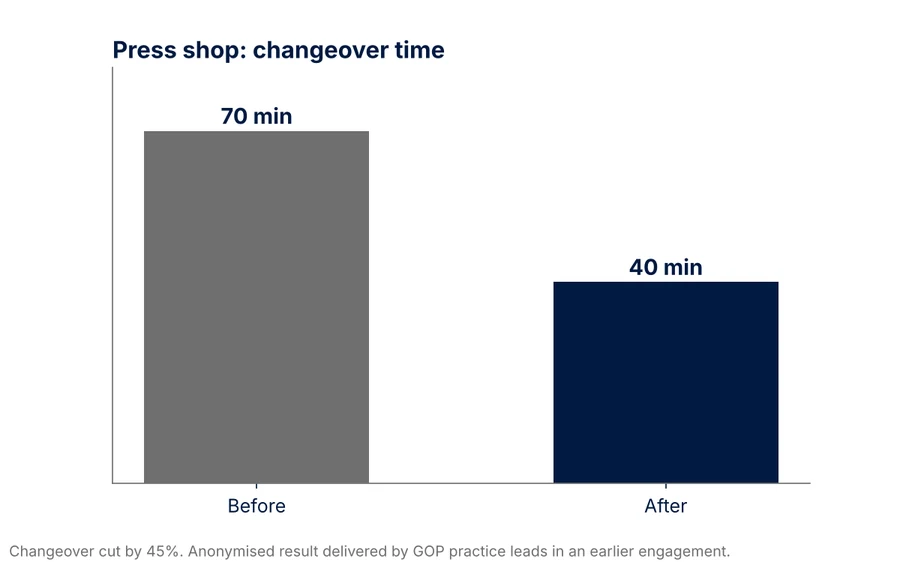
We time every step of changeovers, move preparation outside machine stoppage and standardise the routine. In one press shop, prior-career work cut changeover from 70 to 40 minutes.
Layout and materials handling
We redesign layouts and conveyorised flow to cut walking, handling and waiting, so the same plant does more with less effort.
Procurement, sourcing and supplier performance
We analyse spend by category, rationalise vendors, negotiate on total landed cost, and track supplier quality and delivery on a scoreboard your purchasing team owns.
Working-capital discipline, operating reviews and accountability
We link inventory, receivables and payables to owners, set a daily or weekly operating review with cross-functional attendance, and make every metric visible to the person who can move it.
Our approach
- Establish the performance baseline.
- Identify the most material improvement opportunities.
- Assess feasibility, cost and execution requirements.
- Agree on initiatives and owners.
- Track progress against a documented baseline.
- Review whether improvements are realised and sustained.
How progress is measured
- Installed and effective capacity per line
- Changeover time (average and worst case)
- Manpower per unit and productivity
- Landed cost per unit
- Inventory days and cash conversion cycle
- Supplier on-time delivery and quality
Who this lever is for
Promoter-led manufacturers under growth pressure on capacity or margin: fans and motors, home appliances, electricals and switchgear, heat exchangers, engineering components, paper and packaging, FMCG and consumer durables. It also suits PE/VC portfolio companies whose investment thesis depends on margin improvement or on scaling output without a matching rise in cost.
How GOP works on this lever
GOP works as operators alongside the promoter, not as external advisors. Every engagement starts with a fixed-scope diagnostic, moves to a sequenced roadmap with owners, and then to implementation inside your team against agreed measures. See our approach, or read about the other capabilities.
Common mistakes to avoid
- Buying machines before measuring losses on existing ones.
- Improving a single process and moving the bottleneck instead of raising output.
- Claiming savings without an agreed baseline and method.
- Treating improvement as a project instead of a daily routine.
Questions to ask yourself before starting
- Do we know our changeover times and our line balance?
- Is our floor space used for work in process rather than value-adding work?
- Does a daily routine keep improvements in place?
A hypothetical scenario
Hypothetical, for illustration only. Not a client case. A fabrication unit runs at a quarter below its planned output while orders back up. A diagnostic finds long changeovers, material waiting between stations and a layout that forces long moves. Changing sequence, preparing changeovers outside machine stoppage and installing a daily line board lifts output on the same equipment, so the planned machine purchase is deferred.
Frequently asked questions
Can GOP help reduce costs?
GOP can help identify and prioritise cost and productivity opportunities. Actual savings depend on the baseline, scope and execution.
How should savings be measured?
Agree on the baseline, period, calculation method and treatment of one-off costs before claiming an outcome.
Can operational improvements support growth?
Yes. Better processes, productivity and management routines can support more scalable execution, although results depend on the specific business.
Do we need new machinery to raise capacity?
Often not. Most early gains come from flow, changeover and layout. New machinery makes sense once the existing assets are running at their potential.
Related reading
Discuss Operational Improvement
Share where your business is today and where you want it to be. We will tell you honestly whether and how we can help.