
OEM supplier development: what Tier-2 and Tier-3 suppliers need
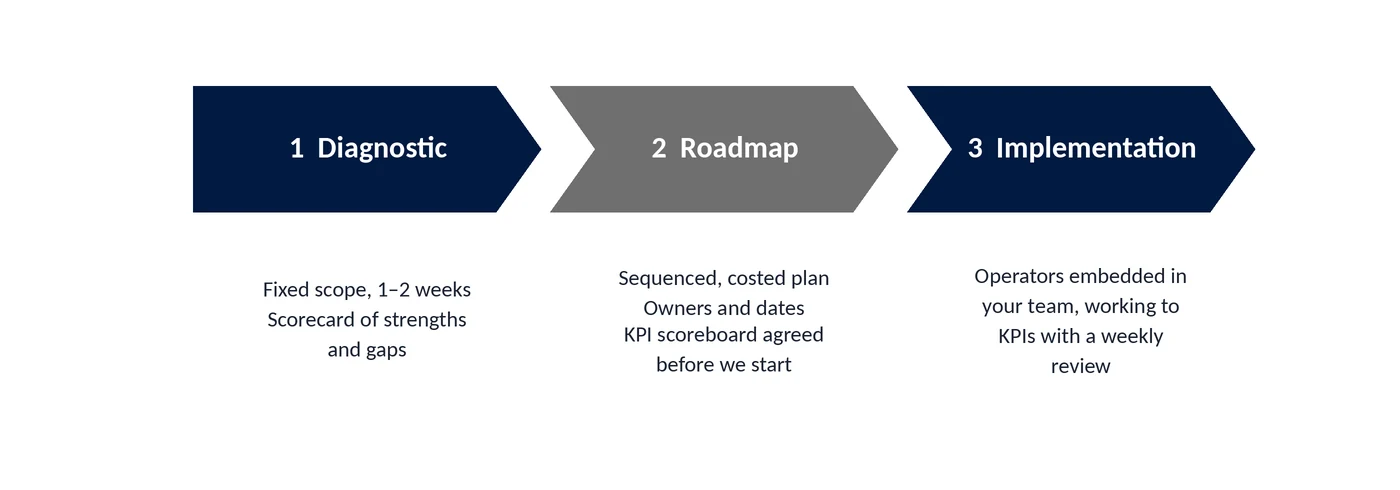
Smaller suppliers lose OEM business less from lack of skill than from lack of systems, capacity and capital for improvement. A supplier capability programme closes those gaps: an assessment against the OEM's own audit criteria, a prioritised plan with owners, hands-on fixes in quality and flow, and re-assessment, with final approval staying with the OEM.
What OEMs expect
- Quality systems with root-cause discipline, such as 8D and SCAR, and process controls such as APQP and PPAP
- Delivery reliability and capacity planning
- Cost competitiveness and continuous improvement
- Audit-ready documentation and compliance
Where suppliers struggle
Quality is inspected rather than built in. Capacity is unmeasured, and OEE is rarely tracked. The promoter handles every decision. Growth capital and management depth are thin. These are normal for smaller firms, and they are the gaps a capability programme closes.
What a capability programme should cover
- Gap assessment against the OEM's own audit criteria.
- A prioritised improvement plan with owners and dates.
- Hands-on closure of gaps in process, quality and flow.
- Re-assessment and reporting. Final approval always stays with the OEM's own quality function.
What OEMs can do
OEMs often treat supplier development as an audit function: visit, score, issue findings, revisit. That finds problems but rarely fixes them, because the supplier lacks the people to act on the findings. Programmes work better when the OEM shares its forecast early so suppliers can plan capacity, agrees a small number of improvement targets per supplier rather than a long list, and funds or co-funds hands-on help on the floor. The return is fewer line stoppages, fewer quality escapes and a supply base that can grow with the OEM.
Beyond quality
A stronger supplier also benefits from better costing, commercial discipline, governance and, where appropriate, introductions to growth investors. Capable Tier-2 and Tier-3 suppliers are an underserved part of the manufacturing chain, and improving them improves the OEM's resilience too.
GOP's practice leads bring plant-floor and supply chain experience to this work. See Operational Excellence & Cost Optimization.
Common mistakes
- Preparing for an audit only in the weeks before it, instead of building systems that run daily.
- Fixing the audit findings without addressing the root causes.
- Treating capacity and OEE as production-team concerns rather than management metrics.
- Leaving growth capital and management depth for later.
A checklist you can use this week
- Obtain the OEM's quality manual and audit criteria and score yourself against them.
- Pick three recurring defects and run a root-cause analysis on each.
- Measure OEE on your most critical line for a month.
- Check on-time delivery performance against the OEM's targets.
- List what management bandwidth you would need to double volumes.
Frequently asked questions
Who pays for supplier improvement?
Models vary. In some, the supplier pays for the audit and improvement work because it improves its own business and standing with the OEM. The arrangement is agreed case by case.
How long does supplier onboarding take?
It depends on how large the gaps are against the OEM's criteria. A gap assessment gives a realistic plan and timeline before work starts.
What if we fail an audit?
A failed audit is information. A structured improvement plan, gap closure and re-audit is the normal route back, and the OEM's quality function makes the final decision.
Related reading
Talk to GOP
Share where your business is today and where you want it to be. We will tell you honestly whether and how we can help.