
How manufacturers can double capacity without new floor space
Many plants are short of flow, not space. Capacity can double when waiting, rework, changeovers and handling are removed, and when work is pulled through the plant at the pace of demand. The method is value-flow mapping, takt time, a layout redesigned for pull, shorter changeovers and daily management that holds the gain.
Why plants feel full when they are not
Machines are occupied, people are busy and floors are crowded with work in process. Yet only a fraction of that activity adds value. The rest is waiting for material, waiting for the next batch, changing over, walking and reworking. Removing it releases capacity that was already paid for.
Method
- Map value flow from raw material to dispatch and mark where work waits.
- Set takt time to customer demand, so each process knows the pace it must meet.
- Redesign layout and sequence for pull instead of batch push.
- Cut changeover and handling time with preparation outside stoppage and shorter moves.
- Install daily management against capacity and quality KPIs so gains hold.
Prior-career results of GOP's practice leads
These results are anonymised. They are prior-career work by the senior practitioners who now lead GOP's manufacturing and supply chain practice, done before GOP, and are not GOP client results.
- Heat exchangers: installed capacity doubled with no additional floor space.
- Press shop: changeover cut from 70 to 40 minutes, a 45% reduction.
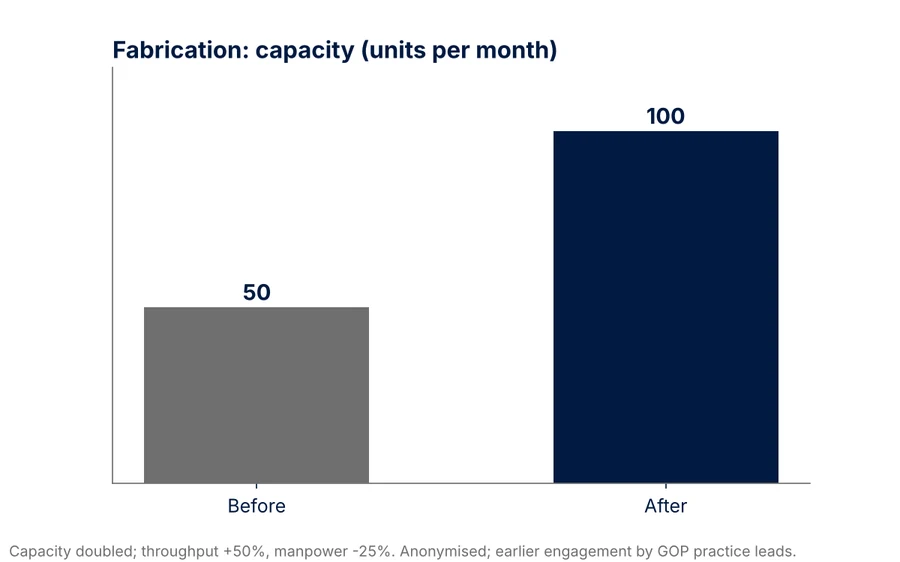
- Fabrication: throughput up 50%, productivity up 60%, capacity doubled from 50 to 100 units a month, manpower down 25% and footprint 40% smaller.
- Fan manufacturer, new plant (6 lakh units a month): manpower optimised by 32% (from 817 to 558) in a plant built in 40% less space than conventional design.
- Materials handling redesign: a plant brought live with 60% manpower optimisation through conveyorised flow.
See all results on the results page.
What to do first
Measure three things on your busiest line: changeover time, line balance and walking or handling distance. They usually show the quickest gains. For the changeover method in detail, read how to cut changeover time.
Common mistakes
- Adding machines before measuring where time is actually lost on the existing ones.
- Improving one process in isolation, which moves the bottleneck without raising output.
- Running large batches to avoid changeovers, which builds work in process and hides problems.
- Treating improvement as a project instead of installing a daily routine that holds the gain.
A checklist you can use this week
- Time ten consecutive changeovers on your busiest line and note the longest.
- Draw the material path on a floor plan and mark every move and wait.
- Calculate takt time from monthly demand and available hours, then compare it with each process.
- Count work in process between each pair of operations.
- Pick one line and one KPI, and review it at the line every day for a month.
Frequently asked questions
Do we need new machinery?
Usually not at first. Most early gains come from flow, layout and changeover. New machines should be considered only after existing assets run at their potential.
How fast do results show?
The first changes on a chosen line can show within weeks. Wider gains build over a quarter or more as the routines spread to other lines.
Does this work in job-shop environments?
Yes, with adaptation. Job shops gain mainly from changeover reduction, scheduling discipline and cell-based layouts rather than pure takt-based flow.
Related reading
Talk to GOP
Share where your business is today and where you want it to be. We will tell you honestly whether and how we can help.