
How to cut changeover time in a press shop or machining line
Changeover time is lost production time. Reducing it frees capacity without new machines and allows smaller batches. The SMED method records the changeover, separates work that needs the machine stopped from work that does not, moves preparation outside the stoppage, shortens what remains and makes the new routine standard work.
Method (SMED: single-minute exchange of die)
- Record the changeover on video and time each step.
- Separate internal from external work. Internal steps need the machine stopped. External steps, such as fetching tools, staging material and pre-heating, can happen while it runs.
- Move external work outside the stoppage.
- Shorten internal steps with quick clamps, standard heights, locating pins and pre-set tooling.
- Standardise and train, then audit the routine weekly.
Example (anonymised)
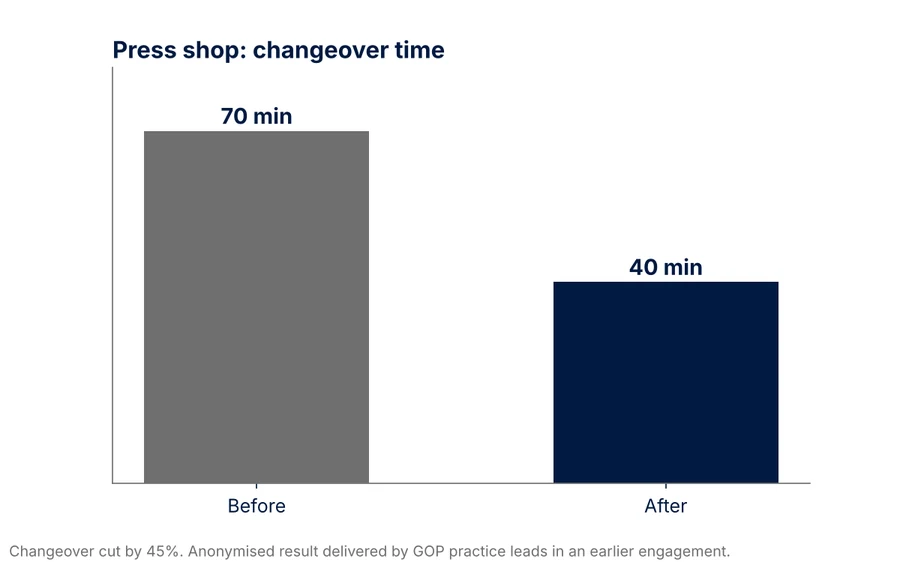
In a press shop, changeover fell from 70 to 40 minutes, a 45% reduction, which directly raised available production hours. This was prior-career work by GOP practice leads, before GOP, and is not a GOP client result.
Where to look first
Searching for tools, waiting for material or approval, and trial runs and adjustments usually hold the largest share of lost time. Fixing these needs discipline and standard work more than capital. A shadow board for tools, a staged trolley with the next job's material and documents, and a first-off approval that is planned rather than requested usually come before any new hardware.
Who should be in the room
Changeover improvement is a shop-floor exercise, not an engineering study. The people who do the changeover every shift know where the time goes: the clamp that needs two people, the die that is stored at the far end of the bay, the first-off inspection that waits for a quality engineer on another line. Put the setter, the operator, the line supervisor and someone from maintenance and quality together in front of the video. Let them propose the changes. Standard work that operators wrote themselves is the standard work that survives the next shift change.
What to measure
- Average and worst-case changeover time per line
- Number of changeovers per shift
- Available production hours gained
Shorter changeovers allow smaller batches, which cut work in process and speed up response to customers. This is one of the building blocks of doubling capacity without new floor space.
Common mistakes
- Timing only the average changeover and ignoring the worst cases.
- Making improvements without standard work, so they fade within weeks.
- Buying expensive quick-change tooling before fixing preparation.
- Leaving operators out of the redesign.
A checklist you can use this week
- Film the next changeover from the last good part to the first good part.
- Mark every step as internal (machine stopped) or external (can be done while running).
- Prepare tools, material and documents before the machine stops.
- Write a one-page standard routine with steps and target times.
- Review changeover times weekly and discuss the longest.
Frequently asked questions
Does SMED need new tooling?
Sometimes small items such as clamps, pins or carts help, but the largest gains typically come from preparation and standard work, which cost little.
How long does it take to see results?
On a chosen line, measurable gains can show within weeks once the changeover is recorded and the first changes are made.
Does it apply outside press shops?
Yes. The same logic applies to machining, moulding, packaging lines and any process where setup interrupts production.
Related reading
Talk to GOP
Share where your business is today and where you want it to be. We will tell you honestly whether and how we can help.