
Working capital discipline for mid-size manufacturers
Working capital discipline means running inventory, receivables and payables to agreed norms instead of letting them drift with growth. Measure the cash conversion cycle, set norms by item and customer category, give each one an owner and review them weekly. Most of the cash released comes from inventory and collections, not from stretching suppliers.
Why working capital tightens as you grow
Growth consumes cash. More orders mean more material bought ahead, more finished goods in transit and more invoices waiting to be paid. In a promoter-led company, the response is often to extend the bank limit and push suppliers for longer credit. That works until the limit is full, and it hides the real issue: inventory and receivables that have grown faster than sales.
Lenders and investors notice. Working capital days that rise year after year are one of the first things a credit committee or an investor will question.
Measure the cycle first
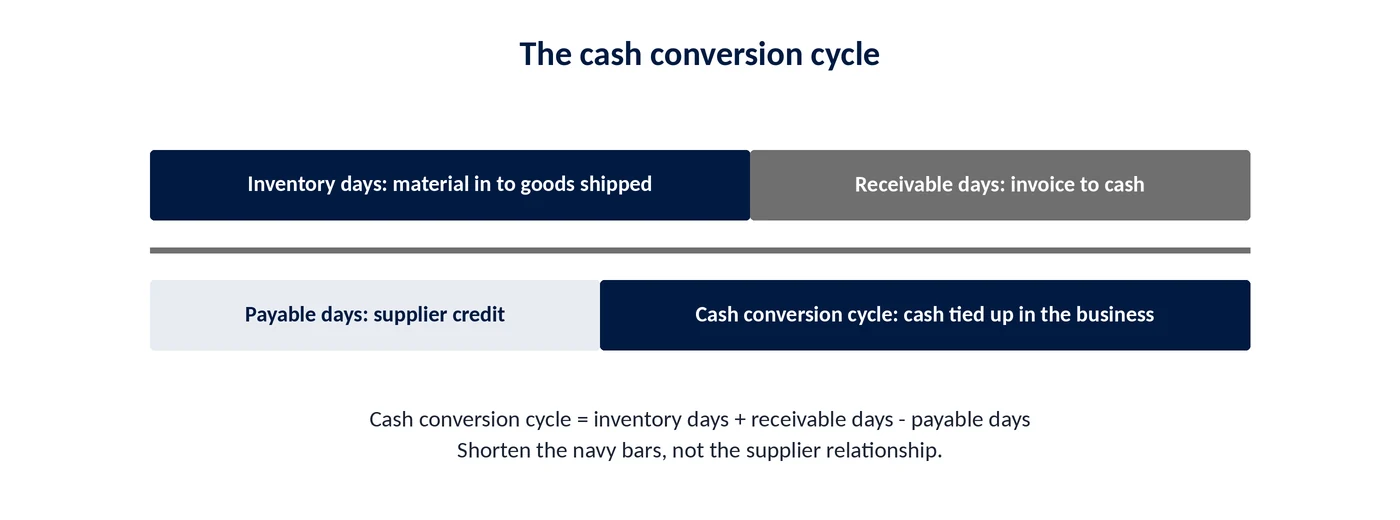
The cash conversion cycle is inventory days plus receivable days, minus payable days. Calculate it monthly from the balance sheet, and then break each part down. Inventory by raw material, work in process and finished goods. Receivables by customer and by age. Payables by supplier. The breakdown matters more than the total, because each part has a different owner and a different fix.
Inventory: where most of the cash sits
- Classify items by value and movement, and set stock norms for each class rather than one number for everything.
- Find slow-moving and non-moving stock and decide what to use, rework, sell or write off.
- Cut work in process by fixing flow: shorter changeovers allow smaller batches, and smaller batches mean less stock between operations.
- Link purchasing to the production plan and real demand, not to minimum order quantities alone.
Receivables: make collection part of selling
Agree payment terms by customer category and put them in the quote, not only in the invoice. Give the salesperson who owns the account a target for overdue receivables, not just for orders. Review the ageing list every week, customer by customer, and escalate early. Customers who pay late consistently should be priced for it or moved to tighter terms.
Payables: fair, not stretched
Paying suppliers later releases cash on paper but often costs more in price, priority and quality, especially for smaller suppliers. Negotiate terms openly, pay on the agreed date, and use reliability to earn better terms or prices. The aim is a stable, predictable cycle, not one built on squeezing the supply base.
Make it routine
A thirty-minute weekly review of inventory norms, overdue receivables and the cash forecast, with owners reporting against their own numbers, does more than any one-off clean-up. This rhythm is part of GOP's Governance & Investment Readiness and Commercial Excellence work.
Common mistakes
- Solving a cash squeeze by extending the bank limit instead of finding where cash is stuck.
- Setting one inventory norm for all items regardless of value and movement.
- Measuring sales teams on orders booked, never on cash collected.
- Stretching small suppliers until they deprioritise your orders.
A checklist you can use this week
- Calculate inventory, receivable and payable days for each of the last twelve months.
- List the twenty largest items of slow-moving or non-moving stock.
- Pull the receivables ageing list and name an owner for every overdue account.
- Check whether payment terms are written into quotes as well as invoices.
- Set a fixed weekly slot to review the cash forecast with owners.
Frequently asked questions
What is a good cash conversion cycle?
It depends on the industry, the product and the customers. Compare against your own history and against similar businesses, and focus on the trend and the breakdown rather than one target number.
Should we offer discounts for early payment?
Only if the discount costs less than the cash it releases, and only if customers who take it actually pay early. Track it, because the discount is often taken without the early payment.
Can software fix working capital?
Software helps with visibility. The cash comes from decisions: norms, terms, purchasing rules and a weekly review that holds owners to them.
Related reading
Talk to GOP
Share where your business is today and where you want it to be. We will tell you honestly whether and how we can help.