
Costing architecture: how manufacturers find true product margin
Costing architecture is the set of rules that turns what a plant spends into a cost for each product and customer. A sound one costs material at actual yield, conversion by machine and labour hours, overheads by driver, and the cost to serve each account, so margin decisions rest on contribution rather than a blended average.
Why blended costing misleads
Most promoter-led manufacturers start with a costing sheet built for quoting: material at standard, a labour rate, and a percentage added for overheads. It works while the product range is small and customers are similar. As the business grows, the same percentage is spread across products that use the plant very differently. A short-run, high-changeover product carries the same overhead loading as a long-run commodity. A customer who orders small lots, pays late and claims often looks as profitable as one who does none of these things.
The result is predictable. Complex products are underpriced, simple ones are overpriced, and the sales team chases volume in exactly the places where margin is thinnest.
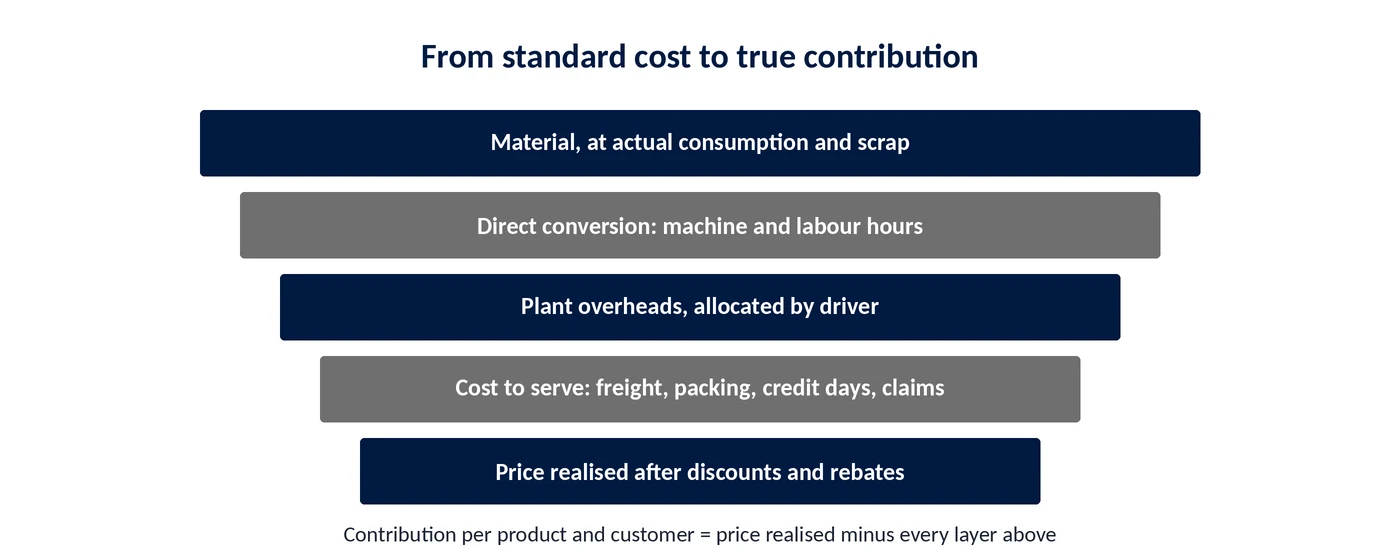
The five layers
- Material at actual consumption. Use real yield, scrap and rework from the shop floor, not the bill-of-materials standard.
- Direct conversion. Cost machine hours and labour hours separately, and include changeover time against the product that causes it.
- Plant overheads by driver. Allocate power, maintenance, quality and supervision on what drives them, such as machine hours, batches or inspections, rather than on sales value.
- Cost to serve. Freight, packing, credit days, claims, samples and service visits belong to the customer, not to the product.
- Price realised. Start from the invoice after discounts, rebates and credit notes, not the list price.
How to build it without a new ERP
Start with a spreadsheet model for the top products and customers that make up most of revenue. Pull twelve months of invoices, credit notes, production records and the expense ledger. Agree the allocation drivers with finance and the plant head, and write them down. Run the model, then test it against the monthly profit and loss: if product contributions do not add back to the plant result, a cost is missing or counted twice.
Once the model reconciles and the leadership team trusts it, move the logic into the ERP or reporting tool. Doing it the other way round, by configuring software first, usually hard-codes the old assumptions.
Using it once it exists
The point of costing is decisions. Re-price or re-specify the products that lose money after full cost. Change terms for customers whose cost to serve wipes out their margin. Set a contribution floor for quotes so the sales team knows when to walk away. And review the model each quarter, because product mix, input prices and customer behaviour move. This work sits inside GOP's Commercial Excellence and Operational Excellence levers.
Common mistakes
- Allocating overheads as a percentage of sales, which hides the cost of complexity.
- Using bill-of-materials standards when actual yield and scrap are very different.
- Leaving freight, credit days and claims out of customer profitability.
- Building the model in software before the logic has been agreed and tested.
A checklist you can use this week
- List the products and customers that together make up most of your revenue.
- Compare standard material cost with actual consumption for the top ten products.
- Choose one driver for each major overhead and write it down.
- Add freight, credit days and claims to the profitability view of your largest customers.
- Check that product contributions add back to last month's plant profit.
Frequently asked questions
Is activity-based costing necessary?
Full activity-based costing is rarely needed. Allocating the largest overheads by a sensible driver captures most of the insight with far less effort.
How often should costs be updated?
Update input prices monthly where they move quickly, and review allocation drivers and yields each quarter or when the product mix changes.
Who should own the costing model?
Finance owns the model and its integrity. The plant head owns the operational inputs, and sales uses the outputs for pricing decisions.
Related reading
Talk to GOP
Share where your business is today and where you want it to be. We will tell you honestly whether and how we can help.