
What investors diligence in an INR 150-500 crore manufacturer
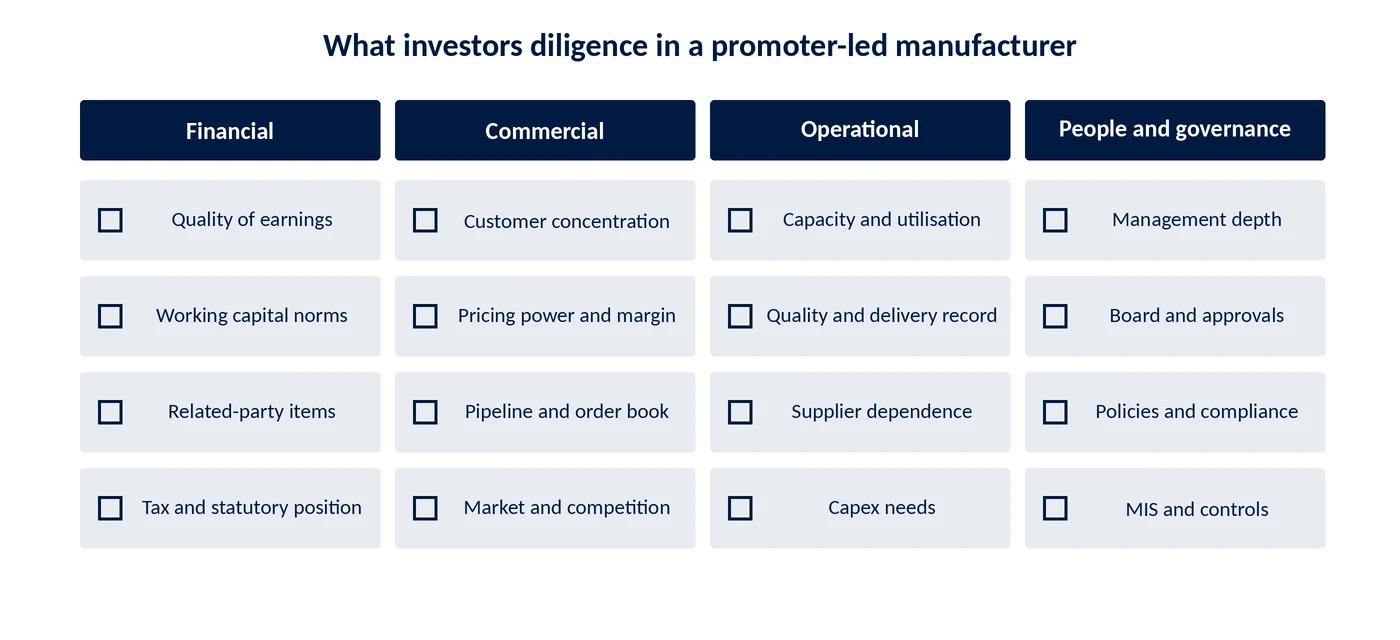
Investors diligencing a promoter-led manufacturer test four things: whether the earnings are real and repeatable, whether revenue is durable, whether the plant can deliver the growth plan, and whether the business can run without depending on one person. Preparing means answering those questions yourself, with evidence, before an investor asks them.
Financial diligence
The financial stream asks what the business really earns and how much cash it needs. Expect questions on quality of earnings, normalised EBITDA, related-party transactions, working capital norms and seasonality, debt and contingent liabilities, and the tax and statutory position. Reviewers will reconcile your management numbers with the audited accounts and ask about every gap. Read QoE-grade reporting basics for how to prepare.
Commercial diligence
The commercial stream asks whether revenue will last and grow. Investors look at customer concentration and the strength of the largest relationships, pricing power and margin trends by product and customer, the order book and pipeline, win and loss history, market growth and competitive position. In a promoter-led company they will also ask how many key customer relationships depend on the promoter personally.
Operational diligence
The operational stream asks whether the plant can deliver the plan. Expect a site visit and questions on installed and effective capacity, utilisation, quality and delivery performance, dependence on particular suppliers, maintenance, safety and environmental compliance, and the capital expenditure needed to reach the growth targets. A plan that assumes more output than the plant can produce, without a costed capex line, is quickly challenged.
People and governance diligence
The fourth stream asks who runs the business and how decisions are made. Investors look at the depth of the management team beyond the promoter, key-person risk, the board and how often it meets, the delegation of authority, policies and compliance, and the quality of the MIS and internal controls. This is often where promoter-led companies have the most to do, and where preparation pays back most visibly.
How to prepare
- Run your own readiness review against these four streams and rank the gaps by importance and effort.
- Fix what can be fixed in the time available: reconciliations, documentation of related-party items, a working board calendar, a delegation of authority.
- Prepare explanations for what cannot be fixed quickly, with a credible plan and owner for each.
- Build a data room organised by stream, with the documents an investor will request, before the first request arrives.
- Prepare the team: the functional heads who will meet investors should know their numbers without the promoter in the room.
Diligence is not only a test. Done well, it is the moment a business shows that it already runs as an institution. That is the work of GOP's Governance & Investment Readiness lever. Legal, tax and accounting diligence remain with the qualified advisers on each side.
Not legal or financial advice. This article is general information about how investors typically approach due diligence. The scope of any diligence depends on the investor and the transaction. Take advice from your legal counsel, chartered accountants and transaction advisers before acting.
Common mistakes
- Waiting for the investor's request list before organising documents.
- Presenting a growth plan that the plant cannot deliver without unplanned capex.
- Letting the promoter answer every question, which highlights key-person risk.
- Hiding known issues instead of explaining them with a plan.
A checklist you can use this week
- Score your business against the four diligence streams and list the top five gaps.
- Reconcile management and audited profit for the last three years.
- Calculate revenue share from your top five customers and how many depend on the promoter.
- Compare installed capacity with the volume your growth plan assumes.
- Create a data-room folder structure by stream and start filling it.
Frequently asked questions
How long does due diligence take?
It varies with the size and complexity of the business and the transaction. Preparation done in advance shortens it and reduces the number of surprises.
Who pays for due diligence?
Arrangements differ by transaction. Typically each side pays its own advisers; agree this early with your transaction advisers.
What is a vendor due diligence?
A review commissioned by the company or seller, shared with prospective investors. Whether it suits your situation is a question for your transaction advisers.
Related reading
Talk to GOP
Share where your business is today and where you want it to be. We will tell you honestly whether and how we can help.