
How to make a family-run manufacturing business PE-ready
A promoter-led manufacturer becomes PE-ready when an outsider can trust its numbers, its people and its growth plan without relying on the promoter's memory. Investors fund institutions, not individuals. That means reconciled numbers by product and customer, revenue that does not hang on a few relationships, managers who can run the business without the promoter, and a functioning board.
What private equity investors look at
Every investor has its own checklist, but the questions behind them are similar across mid-market deals in manufacturing.
- Financial credibility: audited and consistent financials, clean related-party transactions, and a reconciled view of margin by product and customer.
- Revenue quality: customer concentration, repeat business, pricing power and a visible pipeline.
- Management depth: can the business run for a month without the promoter in the room?
- Governance: a functioning board, defined delegation of authority and MIS that arrives on time.
- Growth plan: a costed plan, with owners, that explains how new capital turns into earnings.
Where promoter-led companies usually stall
Decisions sit with one person. Reports arrive late and differ between departments. Sales depends on a few relationships. None of this is unusual, and all of it is fixable. The risk is that an investor finds these issues during due diligence and prices them in, or walks away. Finding them first gives you control of the story.
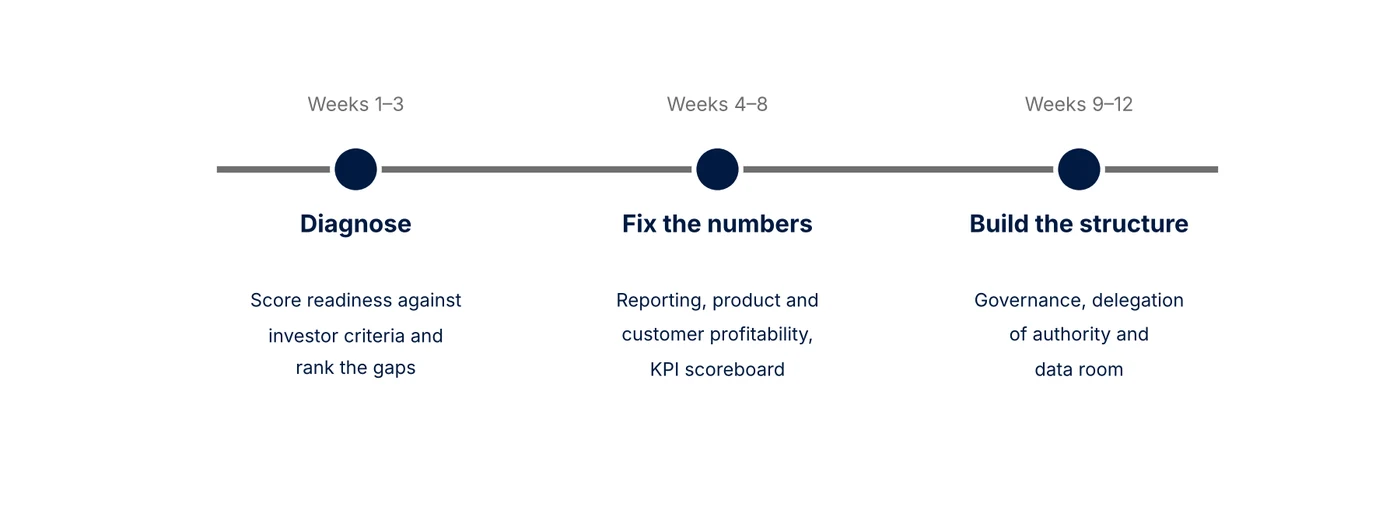
A 90-day sequence
- Weeks 1-3: diagnose. Score readiness against investor criteria and rank the gaps by importance and effort.
- Weeks 4-8: fix the numbers. Build reporting by product and customer, reconcile management and statutory accounts, and set up a KPI scoreboard with owners.
- Weeks 9-12: build the structure. Put governance, a delegation of authority and a data room in place.
Ninety days will not make a business perfect, but it moves the largest gaps from unknown to managed, and shows investors a credible direction of travel.
Before and after investment
Readiness work does not stop at closing. Investors track performance against agreed KPIs, so the same scoreboard carries into the investment period. That is why GOP works both before and after investment: Investment se pehle bhi. Investment ke baad bhi.
What to do this month
- List your ten most important numbers and check that two people calculate them the same way.
- Write down which decisions only the promoter can make today, and which could be delegated with clear limits.
- Check customer concentration: what share of revenue comes from your top five customers?
GOP's Governance & Investment Readiness lever covers this work in detail.
Common mistakes
- Starting readiness work after investors have already asked for data, so gaps are discovered under time pressure.
- Presenting blended margins that hide loss-making products and customers.
- Treating governance as paperwork, with a board that meets rarely and decides nothing.
- Assuming the promoter's relationships are enough proof of revenue quality.
A checklist you can use this week
- List your ten most important numbers and confirm that finance and operations calculate them the same way.
- Write down the decisions only the promoter makes today, and mark which could be delegated with limits.
- Calculate the share of revenue from your top five customers.
- Check how many days after month-end a reliable MIS pack reaches the leadership team.
- Identify two leaders who could run the business for a month without the promoter, and what support they would need.
Frequently asked questions
How long does PE readiness take?
A first structured pass takes about 90 days, but full readiness often takes 9 to 18 months depending on the starting condition of reporting, governance and management depth.
What is a quality-of-earnings review?
A quality-of-earnings review tests whether reported profits are sustainable and repeatable, by adjusting for one-off items, accounting choices and related-party effects. Investors often commission one during due diligence.
Do we need a board before raising capital?
A functioning board, or at least a regular governance forum with outside perspective, is strongly preferred. It signals discipline and reduces investor concern about promoter dependence.
How much should the promoter retain?
That is a commercial and legal decision that depends on the deal. Take advice from qualified financial and legal advisers before agreeing terms.
Related reading
Talk to GOP
Share where your business is today and where you want it to be. We will tell you honestly whether and how we can help.