
What a growth diagnostic should cover
A growth diagnostic is a time-boxed forensic review that establishes where growth is leaking before you invest more. It should cover true margin, customers, pricing, sales, demand, operations, working capital and governance, and it should end with numbers and a plan, not opinions: a quantified gap to target, a sequenced roadmap and owners.
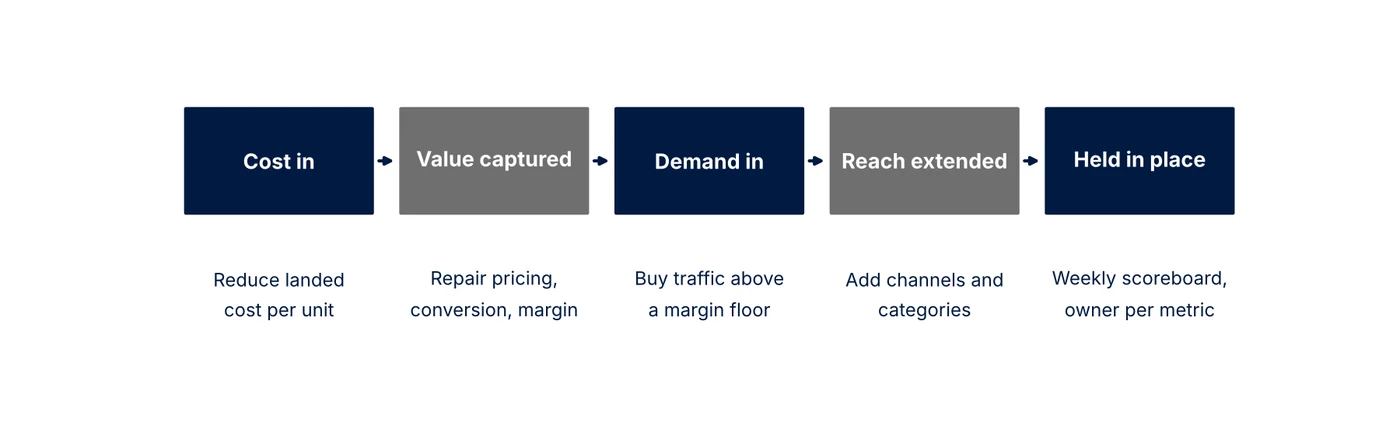
Areas to examine
- True margin by product, customer and channel, including freight, duties, returns and discounts
- Customer base: concentration, geography and repeat behaviour
- Conversion, pricing and discounting
- Sales process and pipeline quality
- Marketing and demand sources: paid versus organic, and cost per qualified enquiry
- Operations, capacity and supply chain
- Inventory and working capital
- Returns, claims and leakage
- Organisation: ownership of KPIs and the decision rhythm
- Governance and reporting
- Expansion readiness for new markets, channels or products
What you should receive
- A true-economics view of the business, not the blended average
- A quantified gap between today's run-rate and your target
- A month-by-month roadmap with owners
- A measurement framework with named owners for each metric
Duration and access
A diagnostic typically takes one to three weeks from the point data access is given. Insist on a fixed scope and a written list of outputs. It is common to ask for reports rather than shared passwords: sales and margin data, pricing sheets, catalogue, logistics and cost sheets, and platform reports where relevant.
Why diagnose first and spend later
Spending on demand before fixing margin multiplies the leak. The order that protects profit is: fix cost, capture value, buy demand, then extend reach. A diagnostic tells you where each of those stands, so money goes first to the place that returns the most.
How to tell a good diagnostic from a weak one
A weak diagnostic restates what the promoter already knows, in better formatting. A good one changes at least one belief. Typical examples: a product line that looks profitable on gross margin turns out to lose money once freight, claims and credit days are allocated; a large customer is found to absorb a disproportionate share of discounts; a capacity constraint blamed on machines turns out to be a material-flow problem.
The test is simple. After reading the findings, can you name the three actions that will move the numbers most, the owner of each, and how you will know within a quarter whether they are working? If not, the diagnostic is not finished.
GOP runs diagnostics as the first step of every engagement. See how we work.
Common mistakes
- Accepting a diagnostic with an open-ended scope and no defined outputs.
- Relying on blended averages that hide where margin is made and lost.
- Skipping the quantified gap between today's run-rate and the target.
- Receiving findings with no owners or dates attached.
A checklist you can use this week
- Agree the scope, duration and outputs in writing before access is given.
- Prepare reports on sales, margin, pricing, logistics and cost by product and customer.
- Name one internal counterpart who can unblock data requests.
- Decide the target the diagnostic should measure the gap against.
- Ask for the scoreboard and metric owners as part of the deliverable.
Frequently asked questions
What data is needed for a diagnostic?
Typically sales and margin data by product and customer, pricing and discount records, cost and logistics sheets, pipeline reports and any platform or advertising reports. The exact list depends on the business.
Who should be involved on our side?
The promoter or business head, finance, sales, operations and anyone who owns pricing or supply decisions. A single internal counterpart coordinates access.
What happens after the diagnostic?
You receive the gap, the roadmap and the scoreboard. You can then run the roadmap yourselves, or ask GOP operators to implement it with your team.
Related reading
Talk to GOP
Share where your business is today and where you want it to be. We will tell you honestly whether and how we can help.