
Why scaling ad spend before fixing unit economics burns cash
Scaling paid demand on weak unit economics multiplies the leak: each extra order costs more than it earns, and the loss hides inside blended averages. The order that protects profit is to cut landed cost, repair pricing and conversion, set a margin floor, and only then raise spend on the products and keywords that clear it.
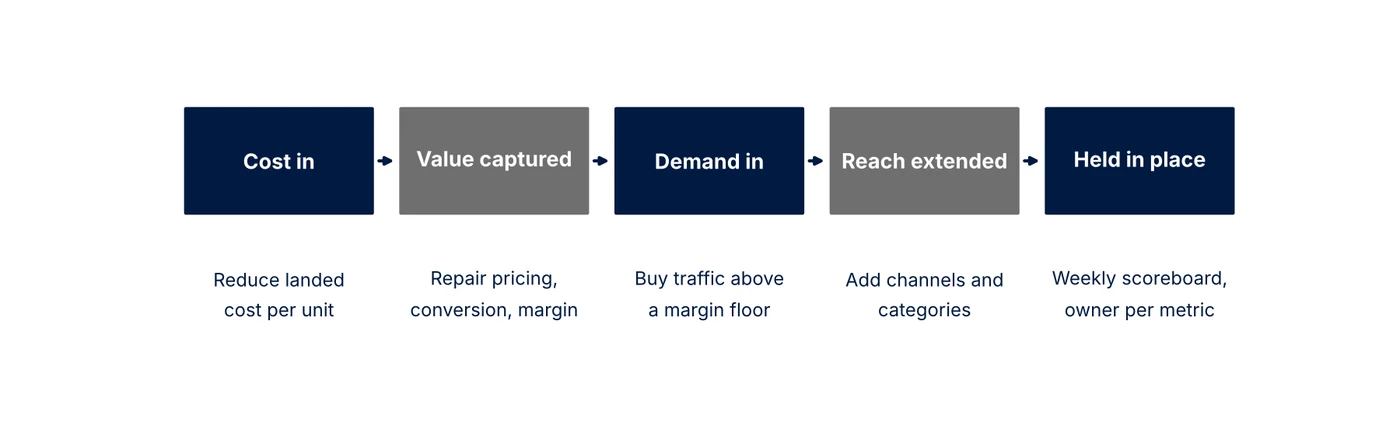
Why it happens
- Paid discovery adds acquisition cost to every sale, so margin falls as spend rises.
- Hidden costs such as returns, freight, duties and discounts are often blended into averages that hide loss-making products.
- Listings, pricing and conversion problems waste the traffic you pay for.
The sequence that works
- Cost in: reduce landed cost per unit. Every rupee removed from cost lands in margin across all markets.
- Value captured: repair pricing, conversion and margin by product before adding spend.
- Demand in: buy traffic only for products and keywords that clear a margin floor.
- Reach extended: add channels and categories on the repaired economics, not the old ones.
- Held in place: a weekly scoreboard with an owner per metric, so the result survives after consultants leave.
What this looks like in a B2B manufacturer
Industrial companies rarely think of themselves as buying demand, but most do. Trade-portal subscriptions, marketplace listings, exhibition stands, distributor schemes and dealer incentives are all paid acquisition. The same trap applies. A scheme that lifts dealer offtake by pushing a low-margin SKU, or a portal that generates enquiries the sales team cannot qualify, adds cost to every order without adding profit.
The fix is the same as for consumer brands: know the contribution of every product and channel after the cost of winning the order, and spend only where that number is positive and defensible.
Metrics to watch
- Margin by product and channel
- Advertising cost as a share of sales
- Conversion rate
- Return rate
- Landed cost per unit
A rule of thumb
Agree a margin floor before raising budget, and cut spend on anything below it. When ad spend scales while margin falls, the answer is almost never more spend. It is usually a listing, pricing or landed-cost problem that the extra traffic is exposing.
This is the order GOP follows in growth mandates. Read more about Demand Generation & Brand Building and Commercial Excellence.
Common mistakes
- Raising ad budgets to hit revenue targets without a margin floor.
- Judging campaigns on revenue per ad rupee while ignoring returns, freight and duties.
- Sending paid traffic to weak or inaccurate product pages.
- Expanding to new channels while the cost base is still leaking.
A checklist you can use this week
- Calculate contribution margin per product after ad cost, returns, freight and duties.
- Set a margin floor and list the products and keywords that fall below it.
- Audit the top ten listings for accurate sizes, specifications and clear imagery.
- Compare landed cost per unit across routes and suppliers.
- Agree a weekly review of margin, ad cost ratio and conversion with a named owner.
Frequently asked questions
What is a healthy ad-cost ratio?
There is no universal number. It depends on gross margin, return rate and lifetime value. Set a margin floor first, then let the ad-cost ceiling follow from it.
How do I find loss-making products?
Build profit by product, after ad cost, returns, freight and discounts. Many catalogues have a few products that earn most of the margin and a tail that loses money.
Should I stop ads while fixing listings?
Not necessarily. Reduce spend on products that clear no margin floor, protect spend on proven products, and fix the weakest listings first.
Related reading
Talk to GOP
Share where your business is today and where you want it to be. We will tell you honestly whether and how we can help.