
Choosing a consultant: operators vs advisors
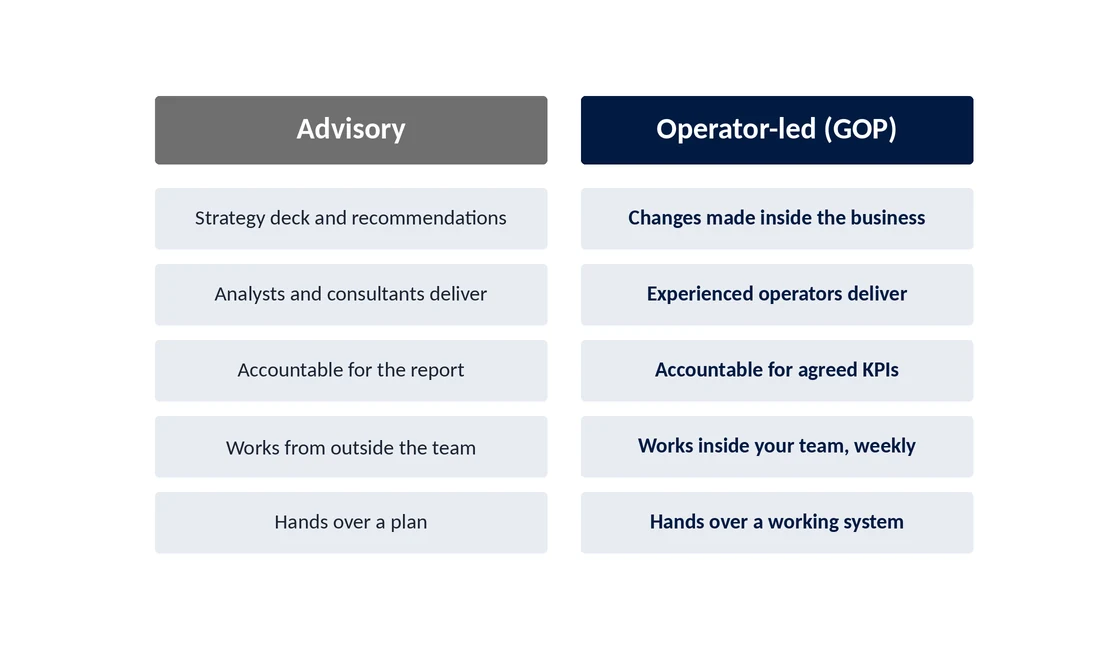
Choose on who will do the work and what they have personally delivered, not on the size of the firm or the quality of the deck. Ask for named people, a baseline and KPIs agreed before signing, and evidence of results in businesses like yours. For execution-heavy change, operators who have run plants and sales teams usually outperform advisors.
Seven questions to ask
- Who exactly will work on my business, and for how long?
- What have they personally run or delivered in a business like mine?
- Which KPIs will you be measured against?
- What will be different in my business in 90 days, and how will we both see it?
- What do you need from my team?
- How will the work continue once you leave?
- Can I speak to someone you have worked with, or see anonymised results?
Red flags
- Senior people pitch, junior people deliver.
- A plan with no named owners.
- No baseline and no measures.
- Success described only as deliverables, never as results.
Where operators help most
Operators help most with execution-heavy changes in cost, capacity, sales systems and governance, where understanding the people on the ground matters as much as the analysis. People who have run businesses know how to turn a plan into daily routines and how to enlist the managers who will make it stick.
Where advisors help most
Advisors help with a specific second opinion, a market study or a one-off decision. The two models can work together: an advisory finding becomes valuable once someone owns the change.
A note on accountability
Every engagement model rewards something. Some reward activity: hours logged, workshops held, slides delivered. Some reward results: a changeover time that falls, a margin that holds, a pipeline that fills. Before you sign, ask what the firm will be measured on and who will read the scoreboard. Then ask what happens if progress is slower than planned. A firm that has thought about that answer has usually done the work before.
How to run the selection
Treat the choice like a senior hire, because that is what it is. Write a one-page brief: where the business is today, the two or three outcomes that matter most in the next year, and what you have already tried. Send the same brief to every firm. The quality of the questions that come back tells you more than the proposal does.
In the first meeting, spend less time on the firm's credentials and more on your own numbers. Good operators will ask about margin by product, order-to-cash time, the share of sales that depends on the promoter and how decisions get made when the promoter is travelling. If a firm can describe a solution before it has seen your data, be careful.
Finally, ask who your internal counterpart should be. Transformation is done by your managers, with help. A partner who insists on a named owner inside the business, and plans to develop that person, is planning for the result to outlast the engagement.
Read how GOP compares with traditional consultants and what operator-led consulting is.
Common mistakes
- Choosing on brand name rather than on who will do the work.
- Accepting a scope that is vague about owners and dates.
- Signing without a baseline, so results cannot be measured.
- Underestimating how much of your own time the engagement needs.
A checklist you can use this week
- Shortlist two or three firms and ask each the seven questions above.
- Ask to meet the people who will actually work on your business.
- Request anonymised results and, where possible, a client conversation.
- Ask each firm what happens if progress is slower than planned.
- Agree the baseline metrics and review cadence before signing.
Frequently asked questions
How long should a diagnostic take?
One to three weeks is typical for a manufacturing business, with the scope and outputs agreed in writing in advance.
Should we hire a consultant or a senior manager?
Hire when the capability is needed permanently. Bring in operators when you need several senior skills at once, for a defined period, and someone to build the team that will carry the work forward.
Where should a smaller manufacturer start?
Start with a diagnostic. It shows where the largest gains are and whether an engagement makes sense for your business before you commit to more.
Related reading
Talk to GOP
Share where your business is today and where you want it to be. We will tell you honestly whether and how we can help.