
How to design an MIS that a promoter-led manufacturer will use
A useful MIS is designed backwards from decisions, not forwards from available data. Build it as a KPI tree that breaks profit and cash into a small set of metrics, give every metric one owner, fix the date the pack arrives, and use the same pack in every review. Keep it short enough to read in fifteen minutes.
Why most MIS packs are ignored
In many mid-size manufacturers the MIS has grown by request. Each time someone wanted a number, a new sheet was added. The pack is now long, arrives late, and is quietly ignored, while the promoter runs the business on phone calls and memory. Different departments bring different numbers to the same meeting, and the discussion is about whose figure is right rather than what to do.
Start from the decisions
List the decisions the leadership team makes every month: what to produce, what to price, whom to chase for payment, what to buy, where to add people. For each decision, ask which number would change it. Those numbers are the MIS. Everything else is reference data that can sit in an appendix or a system.
Build a KPI tree
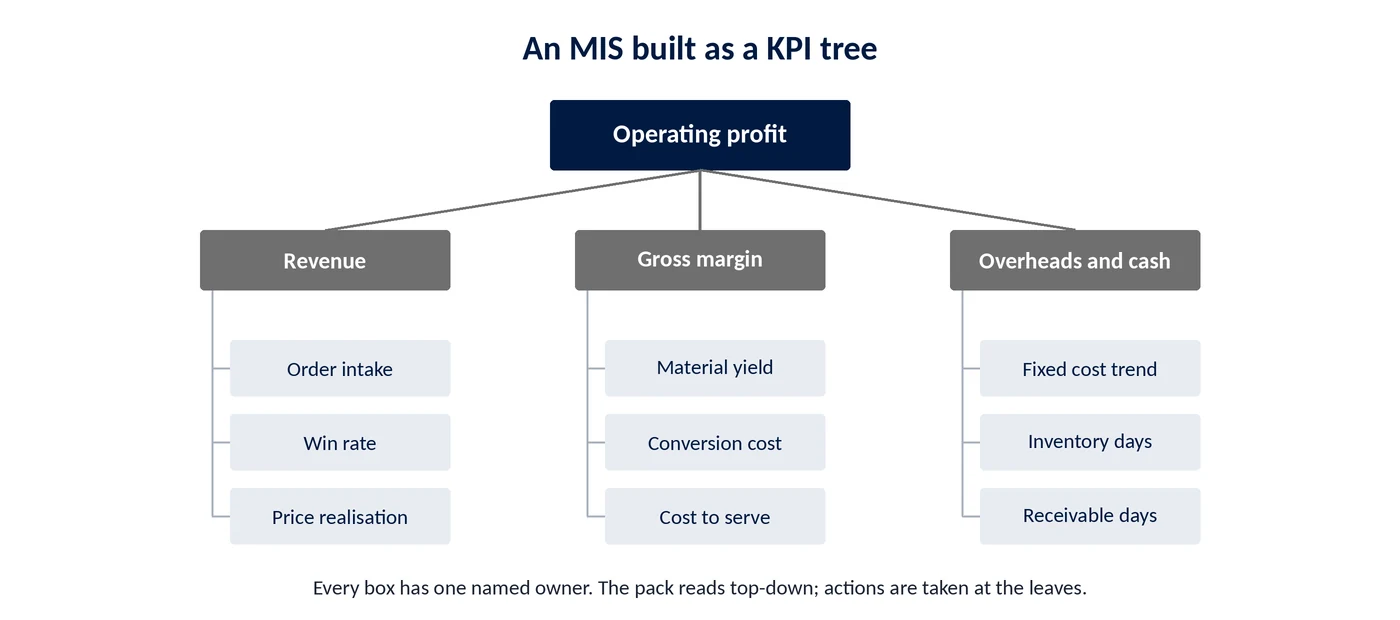
Put the result the promoter cares about at the top, usually operating profit and cash. Break it into a few drivers, such as revenue, gross margin, overheads and working capital. Break each driver into the metrics a manager can actually influence: order intake, win rate, price realisation, material yield, conversion cost, cost to serve, inventory days and receivable days. Stop when each box has one person who can act on it. A tree of fifteen to twenty boxes is enough for most businesses.
Design rules that make it stick
- One owner per metric. The owner explains the variance and proposes the action. Finance produces the number; it does not own the result.
- One definition per metric. Write down how each number is calculated so sales, plant and finance get the same answer.
- A fixed date. Agree the working day by which the pack is circulated, and hold to it. A slightly rough pack on time beats a perfect one a fortnight late.
- Trend, not snapshot. Show each metric against target and against the last few months, so direction is visible.
- Actions alongside numbers. Every metric off target carries a line on what is being done and by whom.
Weekly and monthly layers
Not everything needs to wait for month-end. Order intake, dispatches, overdue receivables and a few plant metrics are worth a short weekly scoreboard. The monthly pack then adds profitability, cost and balance-sheet items once the books close. Keep the structure identical so the weekly view rolls up into the monthly one, and so the board sees a quarterly version of the same tree.
MIS design sits within GOP's Governance & Investment Readiness lever. For the board and governance side, read governance and MIS a mid-size manufacturer needs.
Common mistakes
- Adding a new report every time someone asks a question, until nobody reads the pack.
- Letting finance own every metric instead of the managers who can act on them.
- Allowing different departments to define the same number differently.
- Producing a perfect pack too late for anyone to use it.
A checklist you can use this week
- List the ten decisions your leadership team makes every month.
- Draw a KPI tree from operating profit and cash down to metrics a manager can act on.
- Write a one-line definition for each metric and agree it with sales, plant and finance.
- Name one owner per metric and agree the date the pack will be circulated.
- Run one month on the new pack before adding anything to it.
Frequently asked questions
How long should an MIS pack be?
Short enough to read in fifteen minutes: often a one-page scoreboard with a few supporting pages. Detail can live in appendices or the reporting system.
Do we need a business intelligence tool?
Not to start. Agree the tree, definitions and rhythm in a spreadsheet first. A tool is worth it once the pack is stable and trusted.
How is MIS different from statutory accounts?
Statutory accounts report the past to outsiders on fixed rules. MIS informs management decisions and should reconcile to the accounts, but is organised around what managers control.
Related reading
Talk to GOP
Share where your business is today and where you want it to be. We will tell you honestly whether and how we can help.