
A 90-day transformation plan for a promoter-led manufacturer
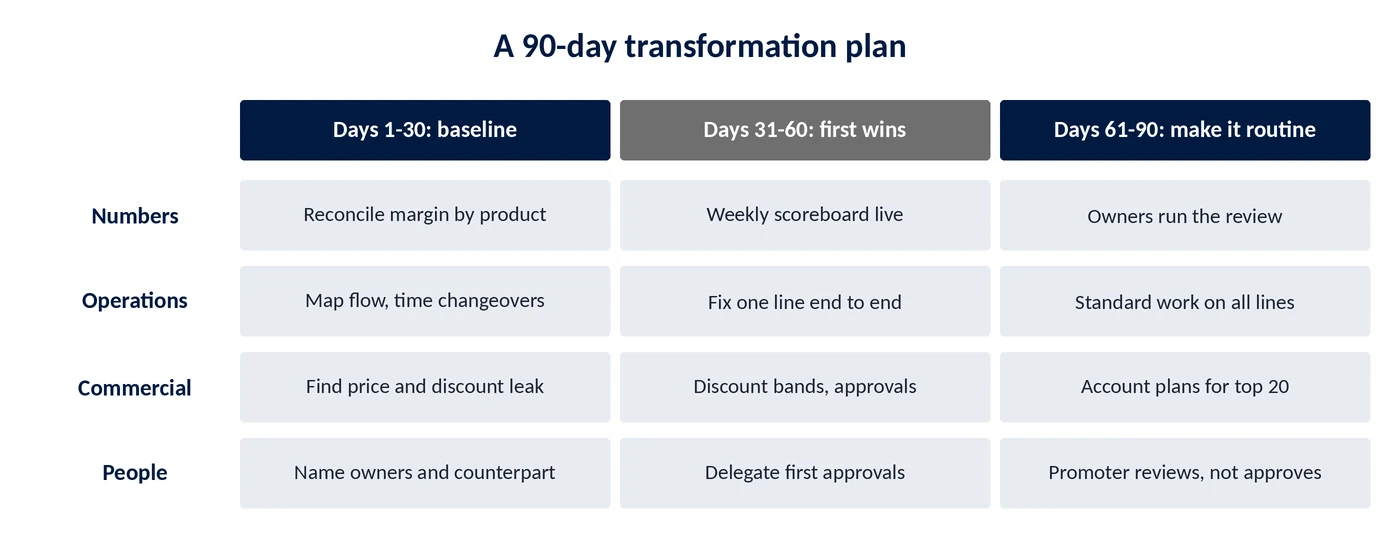
A realistic 90-day plan does not transform a business; it starts a transformation that lasts. The first 30 days set baselines and owners, the next 30 deliver a few visible wins on chosen lines and accounts, and the last 30 turn those wins into weekly routines the team runs without outside help. The promoter moves from approving to reviewing.
Days 1-30: baseline and owners
The first month is about facts. Reconcile the numbers the business already reports and build a first view of margin by product and customer. On the shop floor, map material flow on the busiest lines and time changeovers. In sales, compare list price with realised price and pull the receivables ageing. Name an internal counterpart for the programme and an owner for each workstream. By day 30 the leadership team should agree on three or four KPIs that define success, and their starting values.
Days 31-60: first visible wins
The second month proves the approach on a small scale. Pick one line and fix it end to end: changeover routine, layout tweaks, a daily board at the line. Introduce discount bands and an approval path for exceptions. Start a weekly scoreboard review with the owners. Choose wins that are visible to managers on the floor and in sales, because their trust matters more than the size of the first gain. Delegate the first set of approvals away from the promoter, with clear limits.
Days 61-90: make it routine
The third month spreads what worked and makes it the way the business runs. Extend standard work to the remaining lines. Write account plans for the largest customers. Let the internal counterpart run the weekly review, with the operator coaching rather than leading. Fix the monthly MIS date and structure. By day 90 the promoter should be reviewing the scoreboard rather than approving every decision, and the team should know which levers to pull next quarter.
What to avoid
Ninety-day plans fail in familiar ways. Trying to fix everything at once spreads attention too thin. Starting with a reorganisation before anyone trusts the numbers creates fear without results. Measuring the programme by workshops held rather than metrics moved teaches the team that activity is the goal. And a promoter who overrides the new rules in the first difficult week undoes the rest.
After 90 days
The plan for the next quarter comes from the scoreboard: which levers moved, which did not and why. Most businesses then deepen one or two of GOP's value-creation levers, such as Operational Excellence or Commercial Excellence, while the routines started in the first 90 days keep the gains in place. See how GOP works for the full engagement model.
Common mistakes
- Trying to fix every function at once in the first quarter.
- Reorganising before the numbers are trusted.
- Measuring the programme by activity instead of by KPIs moved.
- The promoter overriding new approval limits under pressure.
A checklist you can use this week
- Choose three or four KPIs that will define success at day 90.
- Name one internal counterpart and give them time to lead the programme.
- Pick one production line and five customer accounts to start on.
- Fix a weekly scoreboard review slot and keep it every week.
- Write down the first approvals the promoter will delegate, with limits.
Frequently asked questions
Can a business really change in 90 days?
The business will not be transformed, but the routines that drive transformation can be running, and the first gains on chosen lines and accounts can be visible.
What does the promoter need to do?
Agree the targets, back the changes in front of the team, keep the weekly review and hand over the approvals that were agreed.
What happens after the first 90 days?
The scoreboard shows which levers moved. The next quarter deepens the most valuable ones and extends the routines across the business.
Related reading
Talk to GOP
Share where your business is today and where you want it to be. We will tell you honestly whether and how we can help.